Look deep into nature, and then you will understand everything better. - Albert Einstein -
Spell Of Autumn
( Lekhni-November-2008)
In the English section : Khalil Zibran , John Keats . Roald Dahl, Robert Louis Stevenson, Shail agrawal. Kid's corner special-an eighteenth century children 's song & an age old all time favourite .
+Vividha with all your news & stories of the month
Listen ... With faint dry sound, Like steps of passing ghosts, The leaves, frost-crisp'd, break free from the trees And fall." - Adelaide Crapsey, 1878-1914, November Night
Autumn; a season of' ' mellow fruitfulness' & falling leaves is once again with us. . Once again evenings are darker and wind sharper and colder. Lot of us loath it, while many consider it as a second spring when every leaf turns into a flower. But then, there is definitely a crispness and clarity about the sky. Some love this bone baring skeleton ot landscape under a starry sky, while there are others, who cannot stand this shivering dark experience; when even one's own shadow deserts in search of sunny shores. D.H. Lawrence in one of his letter wrote;
"The autumn always gets me badly, as it breaks into colours. I want to go south, where there is no autumn, where the cold doesn't crouch over one like a snow-leopard waiting to pounce."
" You can't hide your true colours as you approach the autumn of your life."
How true about man, as well as nature too! I have collected few of my favourite quotes on Autumn which you may like to read and enjoy in the cold, and dark evenings.
-Shail Agrawal
"There is a harmony In autumn, and a luster in its sky, Which through the summer is not heard or seen, As if it could not be, as if it had not been!" - Percy Bysshe Shelley
I prefer winter and fall, when you feel the bone structure of the landscape - the loneliness of it, the dead feeling of winter. Something waits beneath it, the whole story doesn't show." - Andrew Wyeth
"Nature is, above all, profligate. Don't believe them when they tell you how economical and thrifty nature is, whose leaves return to the soil. Wouldn't it be cheaper to leave them on the tree in the first place?" - Annie Dillard
"For man, autumn is a time of harvest, of gathering together. For nature, it is a time of sowing, of scattering abroad." - Edwin Way Teale
No Spring nor Summer Beauty hath such grace As I have seen in one Autumnal face." - John Donne
"Gray drip-wet dawn Leafless tree in solitude - Remembers the robin." - Don Sax
"Nature is, above all, profligate. Don't believe them when they tell you how economical and thrifty nature is, whose leaves return to the soil. Wouldn't it be cheaper to leave them on the tree in the first place?" - Annie Dillard
"A solitary maple on a woodside flames in single scarlet, recalls nothing so much as the daughter of a noble house dressed for a fancy ball, with the whole family gathered around to admire her before she goes." - Henry James
Ah! the year is slowly dying, And the wind in tree-top sighing, Chant his requiem. Thick and fast the leaves are falling, High in air wild birds are calling, Nature's solemn hymn." - Mary Weston Fordham
"Our judgment ripens; our imagination decays. We cannot at once enjoy the flowers of the Spring of life and the fruits of its Autumn." - Thomas Macaulay
How true about man, as well as nature too! I have collected few of my favourite quotes on Autumn which you may like to read and enjoy in the cold, and dark evenings.Any way
Love it , or loath it, like life itself we all have to go through these four seasons. Autumn has got definitely its own sad beauty; if one is in that kind of mood to appreciate. It also reminds us of that inevitability of life itself. It reminds us of its continuity also. One thing which I like about autumn, is its bare expectancy; a crisp yet persistant mood of parting and farewell .
Autumn; a season of' ' mellow fruitfulness' & falling leaves is once again with us. . Once again evenings are darker and wind sharper and colder. Lot of us loath it, while many consider it as a second spring when every leaf turns into a flower. But then, there is definitely a crispness and clarity about the sky. Some love this bone baring skeleton of the landscape under a starry sky, while there are others, who cannot stand this shivering dark experience; when even one's own shadow deserts in search of sunny shores. D.H. Lawrence in one of his letter wrote;
"Winter is an etching, spring a watercolor, summer an oil painting and autumn a mosaic of them all." - Stanley Horowitz
Said a blade of grass to an autumn leaf, "You make such a noise falling! You scatter all my winter dreams."
Said the leaf indignant, "Low-born and low-dwelling! Songless, peevish thing! You live not in the upper air and you cannot tell the sound of singing."
Then the autumn leaf lay down upon the earth and slept. And when spring came she waked again -- and she was a blade of grass.
And when it was autumn and her winter sleep was upon her, and above her through all the air the leaves were falling, she muttered to herself, "O these autumn leaves! They make such a noise! They scatter all my winter dreams."
Season of mists and mellow fruitfulness, Close bosom-friend of the maturing sun; Conspiring with him how to load and bless With fruit the vines that round the thatch-eves run; To bend with apples the moss'd cottage-trees, And fill all fruit with ripeness to the core; To swell the gourd, and plump the hazel shells With a sweet kernel; to set budding more, And still more, later flowers for the bees, Until they think warm days will never cease, For summer has o'er-brimm'd their clammy cells. Who hath not seen thee oft amid thy store? Sometimes whoever seeks abroad may find Thee sitting careless on a granary floor, Thy hair soft-lifted by the winnowing wind; Or on a half-reap'd furrow sound asleep, Drows'd with the fume of poppies, while thy hook Spares the next swath and all its twined flowers: And sometimes like a gleaner thou dost keep Steady thy laden head across a brook; Or by a cyder-press, with patient look, Thou watchest the last oozings hours by hours.
****
Ode To A Grecian Urn
Thou still unravish'd bride of quietness, Thou foster-child of silence and slow time, Sylvan historian, who canst thou express A flowery tale more sweetly than our rhyme: What leaf-fring'd legend haunt about thy shape Of deities or mortals, or of both, In Tempe or the dales of Arcady? What men or gods are these? What maidens loth? What mad pursuit? What struggle to escape? What pipes and timbrels? What wild ecstasy? Heard melodies are sweet, but those unheard Are sweeter: therefore, ye soft pipes, play on; Not to the sensual ear, but, more endear'd, Pipe to the spirit ditties of no tone: Fair youth, beneath the trees, thou canst not leave Thy song, nor ever can those trees be bare; Bold lover, never, never canst thou kiss, Though winning near the goal - yet, do not grieve; She cannot fade, though thou hast not thy bliss, For ever wilt thou love, and she be fair!
Ah, happy, happy boughs! that cannot shed Your leaves, nor ever bid the spring adieu; And, happy melodist, unwearied, For ever piping songs for ever new; More happy love! more happy, happy love! For ever warm and still to be enjoy'd, For ever panting, and for ever young; All breathing human passion far above, That leaves a heart high-sorrowful and cloy'd, A burning forehead, and a parching tongue.
Who are these coming to the sacrifice? To what green altar, O mysterious priest, Lead'st thou that heifer lowing at the skies, And all her silken flanks with garlands drest? What little town by river or sea shore, Or mountain-built with peaceful citadel, Is emptied of this folk, this pious morn? And, little town, thy streets for evermore Will silent be; and not a soul to tell Why thou art desolate, can e'er return.
O Attic shape! Fair attitude! with brede Of marble men and maidens overwrought, With forest branches and the trodden weed; Thou, silent form, dost tease us out of thought As doth eternity: Cold Pastoral! When old age shall this generation waste, Thou shalt remain, in midst of other woe Than ours, a friend to man, to whom thou say'st, "Beauty is truth, truth beauty," - that is all Ye know on earth, and all ye need to know.
Autumn, the season of playful mirth. When a misty hue veils the maiden earth and the wind dances in a spiral and whistle.
When the enchantress moon sprinkles silver dust all over a dark and restless sky. When the frosty bosom of earth quivers at his meaningful glances.
She stretches out to embrace that stooping lofty lover in her arms. Only to find out in the first ray of light the spell broken, the magician gone.
All she has managed to capture on brows of tender petals are her own sweat and tears.
These fragile little dew drops. A memento of a fleeting joy. Ravishing nature begins to lament peeling away newly gained mirage.
Why?
Flowers arranged so proudly, Cared for so lovingly, have started to droop. But a pot can give only what it has got.
Flowers which are on display do have shorter lives. Sometimes rotted by over cologned water, or replaced by an over zealous gardener, simply because its time.
Why to blame or feel sorry? This is the only way of the world.
Old are always on the heap. That is how, don’t you know New shoots do reap.
The room was warm and clean, the curtains drawn, the two table lamps alight-hers and the one by the empty chair opposite. On the sideboard behind her, two tall glasses, soda water, whiskey. Fresh ice cubes in the Thermos bucket.
Mary Maloney was waiting for her husband to come from work.
Now and again she would glance up at the clock, but without anxiety, merely to please herself with the thought that each minute gone by made it nearer the time when he would come. There was a slow smiling air about her, and about everything she did. The drop of a head as she bent over her sewing was curiously tranquil. Her skin -for this was her sixth month with child-had acquired a wonderful translucent quality, the mouth was soft, and the eyes, with their new placid look, seemed larger darker than before. When the clock said ten minutes to five, she began to listen, and a few moments later, punctually as always, she heard the tires on the gravel outside, and the car door slamming, the footsteps passing the window, the key turning in the lock. She laid aside her sewing, stood up, and went forward to kiss him as he came in.
“Hullo darling,” she said.
“Hullo darling,” he answered.
She took his coat and hung it in the closer. Then she walked over and made the drinks, a strongish one for him, a weak one for herself; and soon she was back again in her chair with the sewing, and he in the other, opposite, holding the tall glass with both hands, rocking it so the ice cubes tinkled against the side.
For her, this was always a blissful time of day. She knew he didn’t want to speak much until the first drink was finished, and she, on her side, was content to sit quietly, enjoying his company after the long hours alone in the house. She loved to luxuriate in the presence of this man, and to feel-almost as a sunbather feels the sun-that warm male glow that came out of him to her when they were alone together. She loved him for the way he sat loosely in a chair, for the way he came in a door, or moved slowly across the room with long strides. She loved intent, far look in his eyes when they rested in her, the funny shape of the mouth, and especially the way he remained silent about his tiredness, sitting still with himself until the whiskey had taken some of it away.
“Tired darling?”
“Yes,” he said. “I’m tired,” And as he spoke, he did an unusual thing. He lifted his glass and drained it in one swallow although there was still half of it, at least half of it left.. She wasn’t really watching him, but she knew what he had done because she heard the ice cubes falling back against the bottom of the empty glass when he lowered his arm. He paused a moment, leaning forward in the chair, then he got up and went slowly over to fetch himself another.
“I’ll get it!” she cried, jumping up.
“Sit down,” he said.
When he came back, she noticed that the new drink was dark amber with the quantity of whiskey in it.
“Darling, shall I get your slippers?”
“No.”
She watched him as he began to sip the dark yellow drink, and she could see little oily swirls in the liquid because it was so strong.
“I think it’s a shame,” she said, “that when a policeman gets to be as senior as you, they keep him walking about on his feet all day long.”
He didn’t answer, so she bent her head again and went on with her sewing; bet each time he lifted the drink to his lips, she heard the ice cubes clinking against the side of the glass.
“Darling,” she said. “Would you like me to get you some cheese? I haven’t made any supper because it’s Thursday.”
“No,” he said.
“If you’re too tired to eat out,” she went on, “it’s still not too late. There’s plenty of meat and stuff in the freezer, and you can have it right here and not even move out of the chair.”
Her eyes waited on him for an answer, a smile, a little nod, but he made no sign.
“Anyway,” she went on, “I’ll get you some cheese and crackers first.”
“I don’t want it,” he said.
She moved uneasily in her chair, the large eyes still watching his face. “But you must eat! I’ll fix it anyway, and then you can have it or not, as you like.”
She stood up and placed her sewing on the table by the lamp.
“Sit down,” he said. “Just for a minute, sit down.”
It wasn’t till then that she began to get frightened.
“Go on,” he said. “Sit down.”
She lowered herself back slowly into the chair, watching him all the time with those large, bewildered eyes. He had finished the second drink and was staring down into the glass, frowning.
“Listen,” he said. “I’ve got something to tell you.”
“What is it, darling? What’s the matter?”
He had now become absolutely motionless, and he kept his head down so that the light from the lamp beside him fell across the upper part of his face, leaving the chin and mouth in shadow. She noticed there was a little muscle moving near the corner of his left eye.
“This is going to be a bit of a shock to you, I’m afraid,” he said. “But I’ve thought about it a good deal and I’ve decided the only thing to do is tell you right away. I hope you won’t blame me too much.” “This is going to be a bit of a shock to you, I’m afraid,” he said. “But I’ve thought about it a good deal and I’ve decided the only thing to do is tell you right away. I hope you won’t blame me too much.”
And he told her. It didn’t take long, four or five minutes at most, and she say very still through it all, watching him with a kind of dazed horror as he went further and further away from her with each word.
“So there it is,” he added. “And I know it’s kind of a bad time to be telling you, bet there simply wasn’t any other way. Of course I’ll give you money and see you’re looked after. But there needn’t really be any fuss. I hope not anyway. It wouldn’t be very good for my job.”
Her first instinct was not to believe any of it, to reject it all. It occurred to her that perhaps he hadn’t even spoken, that she herself had imagined the whole thing. Maybe, if she went about her business and acted as though she hadn’t been listening, then later, when she sort of woke up again, she might find none of it had ever happened And he told her. It didn’t take long, four or five minutes at most, and she say very still through it all, watching him with a kind of dazed horror as he went further and further away from her with each word.
“So there it is,” he added. “And I know it’s kind of a bad time to be telling you, bet there simply wasn’t any other way. Of course I’ll give you money and see you’re looked after. But there needn’t really be any fuss. I hope not anyway. It wouldn’t be very good for my job.”
Her first instinct was not to believe any of it, to reject it all. It occurred to her that perhaps he hadn’t even spoken, that she herself had imagined the whole thing. Maybe, if she went about her business and acted as though she hadn’t been listening, then later, when she sort of woke up again, she might find none of it had ever happened.
“I’ll get the supper,” she managed to whisper, and this time he didn’t stop her.
When she walked across the room she couldn’t feel her feet touching the floor. She couldn’t feel anything at all- except a slight nausea and a desire to vomit. Everything was automatic now-down the steps to the cellar, the light switch, the deep freeze, the hand inside the cabinet taking hold of the first object it met. She lifted it out, and looked at it. It was wrapped in paper, so she took off the paper and looked at it again.
A leg of lamb.
All right then, they would have lamb for supper. She carried it upstairs, holding the thin bone-end of it with both her hands, and as she went through the living-room, she saw him standing over by the window with his back to her, and she stopped.
“For God’s sake,” he said, hearing her, but not turning round. “Don’t make supper for me. I’m going out.”
At that point, Mary Maloney simply walked up behind him and without any pause she swung the big frozen leg of lamb high in the air and brought it down as hard as she could on the back of his head.
She might just as well have hit him with a steel club.
She stepped back a pace, waiting, and the funny thing was that he remained standing there for at least four or five seconds, gently swaying. Then he crashed to the carpet.
The violence of the crash, the noise, the small table overturning, helped bring her out of he shock. She came out slowly, feeling cold and surprised, and she stood for a while blinking at the body, still holding the ridiculous piece of meat tight with both hands.
All right, she told herself. So I’ve killed him.
It was extraordinary, now, how clear her mind became all of a sudden. She began thinking very fast. As the wife of a detective, she knew quite well what the penalty would be. That was fine. It made no difference to her. In fact, it would be a relief. On the other hand, what about the child? What were the laws about murderers with unborn children? Did they kill then both-mother and child? Or did they wait until the tenth month? What did they do?
Mary Maloney didn’t know. And she certainly wasn’t prepared to take a chance.
She carried the meat into the kitchen, placed it in a pan, turned the oven on high, and shoved t inside. Then she washed her hands and ran upstairs to the bedroom. She sat down before the mirror, tidied her hair, touched up her lops and face. She tried a smile. It came out rather peculiar. She tried again.
“Hullo Sam,” she said brightly, aloud.
The voice sounded peculiar too.
“I want some potatoes please, Sam. Yes, and I think a can of peas.”
That was better. Both the smile and the voice were coming out better now. She rehearsed it several times more. Then she ran downstairs, took her coat, went out the back door, down the garden, into the street.
It wasn’t six o’clock yet and the lights were still on in the grocery shop.
“Hullo Sam,” she said brightly, smiling at the man behind the counter.
“Why, good evening, Mrs. Maloney. How’re you?”
“I want some potatoes please, Sam. Yes, and I think a can of peas.”
The man turned and reached up behind him on the shelf for the peas.
“Patrick’s decided he’s tired and doesn’t want to eat out tonight,” she told him. “We usually go out Thursdays, you know, and now he’s caught me without any vegetables in the house.”
“Then how about meat, Mrs. Maloney?”
“No, I’ve got meat, thanks. I got a nice leg of lamb from the freezer.”
“Oh.”
“I don’t know much like cooking it frozen, Sam, but I’m taking a chance on it this time. You think it’ll be all right?”
“Personally,” the grocer said, “I don’t believe it makes any difference. You want these Idaho potatoes?”
“Oh yes, that’ll be fine. Two of those.”
“Anything else?” The grocer cocked his head on one side, looking at her pleasantly. “How about afterwards? What you going to give him for afterwards?”
“Well-what would you suggest, Sam?”
The man glanced around his shop. “How about a nice big slice of cheesecake? I know he likes that.”
“Perfect,” she said. “He loves it.”
And when it was all wrapped and she had paid, she put on her brightest smile and said, “Thank you, Sam. Goodnight.”
“Goodnight, Mrs. Maloney. And thank you.”
And now, she told herself as she hurried back, all she was doing now, she was returning home to her husband and he was waiting for his supper; and she must cook it good, and make it as tasty as possible because the poor man was tired; and if, when she entered the house, she happened to find anything unusual, or tragic, or terrible, then naturally it would be a shock and she’d become frantic with grief and horror. Mind you, she wasn’t expecting to find anything. She was just going home with the vegetables. Mrs. Patrick Maloney going home with the vegetables on Thursday evening to cook supper for her husband.
That’s the way, she told herself. Do everything right and natural. Keep things absolutely natural and there’ll be no need for any acting at all.
Therefore, when she entered the kitchen by the back door, she was humming a little tune to herself and smiling.
“Patrick!” she called. “How are you, darling?”
She put the parcel down on the table and went through into the living room; and when she saw him lying there on the floor with his legs doubled up and one arm twisted back underneath his body, it really was rather a shock. All the old love and longing for him welled up inside her, and she ran over to him, knelt down beside him, and began to cry her heart out. It was easy. No acting was necessary.
A few minutes later she got up and went to the phone. She know the number of the police station, and when the man at the other end answered, she cried to him, “Quick! Come quick! Patrick’s dead!”
“Who’s speaking?”
“Mrs. Maloney. Mrs. Patrick Maloney.”
“You mean Patrick Maloney’s dead?”
“I think so,” she sobbed. “He’s lying on the floor and I think he’s dead.”
“Be right over,” the man said.
The car came very quickly, and when she opened the front door, two policeman walked in. She know them both-she know nearly all the man at that precinct-and she fell right into a chair, then went over to join the other one, who was called O’Malley, kneeling by the body.
“Is he dead?” she cried.
“I’m afraid he is. What happened?”
Briefly, she told her story about going out to the grocer and coming back to find him on the floor. While she was talking, crying and talking, Noonan discovered a small patch of congealed blood on the dead man’s head. He showed it to O’Malley who got up at once and hurried to the phone.
Soon, other men began to come into the house. First a doctor, then two detectives, one of whom she know by name. Later, a police photographer arrived and took pictures, and a man who know about fingerprints. There was a great deal of whispering and muttering beside the corpse, and the detectives kept asking her a lot of questions. But they always treated her kindly. She told her story again, this time right from the beginning, when Patrick had come in, and she was sewing, and he was tired, so tired he hadn’t wanted to go out for supper. She told how she’d put the meat in the oven-”it’s there now, cooking”- and how she’d slopped out to the grocer for vegetables, and come back to find him lying on the floor.
Which grocer?” one of the detectives asked.
She told him, and he turned and whispered something to the other detective who immediately went outside into the street.
In fifteen minutes he was back with a page of notes, and there was more whispering, and through her sobbing she heard a few of the whispered phrases-”...acted quite normal...very cheerful...wanted to give him a good supper…peas...cheesecake...impossible that she...”
After a while, the photographer and the doctor departed and two other men came in and took the corpse away on a stretcher. Then the fingerprint man went away. The two detectives remained, and so did the two policeman. They were exceptionally nice to her, and Jack Noonan asked if she wouldn’t rather go somewhere else, to her sister’s house perhaps, or to his own wife who would take care of her and put her up for the night.
No, she said. She didn’t feel she could move even a yard at the moment. Would they mind awfully of she stayed just where she was until she felt better. She didn’t feel too good at the moment, she really didn’t.
Then hadn’t she better lie down on the bed? Jack Noonan asked.
No, she said. She’d like to stay right where she was, in this chair. A little later, perhaps, when she felt better, she would move.
So they left her there while they went about their business, searching the house. Occasionally on of the detectives asked her another question. Sometimes Jack Noonan spoke at her gently as he passed by. Her husband, he told her, had been killed by a blow on the back of the head administered with a heavy blunt instrument, almost certainly a large piece of metal. They were looking for the weapon. The murderer may have taken it with him, but on the other hand he may have thrown it away or hidden it somewhere on the premises.
“It’s the old story,” he said. “Get the weapon, and you’ve got the man.”
Later, one of the detectives came up and sat beside her. Did she know, he asked, of anything in the house that could’ve been used as the weapon? Would she mind having a look around to see if anything was missing-a very big spanner, for example, or a heavy metal vase.
They didn’t have any heavy metal vases, she said.
“Or a big spanner?”
She didn’t think they had a big spanner. But there might be some things like that in the garage.
The search went on. She knew that there were other policemen in the garden all around the house. She could hear their footsteps on the gravel outside, and sometimes she saw a flash of a torch through a chink in the curtains. It began to get late, nearly nine she noticed by the clock on the mantle. The four men searching the rooms seemed to be growing weary, a trifle exasperated.
“Jack,” she said, the next tome Sergeant Noonan went by. “Would you mind giving me a drink?”
“Sure I’ll give you a drink. You mean this whiskey?”
“Yes please. But just a small one. It might make me feel better.”
He handed her the glass.
“Why don’t you have one yourself,” she said. “You must be awfully tired. Please do. You’ve been very good to me.”
“Well,” he answered. “It’s not strictly allowed, but I might take just a drop to keep me going.”
One by one the others came in and were persuaded to take a little nip of whiskey. They stood around rather awkwardly with the drinks in their hands, uncomfortable in her presence, trying to say consoling things to her. Sergeant Noonan wandered into the kitchen, come out quickly and said, “Look, Mrs. Maloney. You know that oven of yours is still on, and the meat still inside.”
“Oh dear me!” she cried. “So it is!”
“I better turn it off for you, hadn’t I?”
“Will you do that, Jack. Thank you so much.”
When the sergeant returned the second time, she looked at him with her large, dark tearful eyes. “Jack Noonan,” she said.
“Yes?”
“Would you do me a small favor-you and these others?”
“We can try, Mrs. Maloney.”
“Well,” she said. “Here you all are, and good friends of dear Patrick’s too, and helping to catch the man who killed him. You must be terrible hungry by now because it’s long past your suppertime, and I know Patrick would never forgive me, God bless his soul, if I allowed you to remain in his house without offering you decent hospitality. Why don’t you eat up that lamb that’s in the oven. It’ll be cooked just right by now.”
“Wouldn’t dream of it,” Sergeant Noonan said.
“Please,” she begged. “Please eat it. Personally I couldn’t tough a thing, certainly not what’s been in the house when he was here. But it’s all right for you. It’d be a favor to me if you’d eat it up. Then you can go on with your work again afterwards.”
There was a good deal of hesitating among the four policemen, but they were clearly hungry, and in the end they were persuaded to go into the kitchen and help themselves. The woman stayed where she was, listening to them speaking among themselves, their voices thick and sloppy because their mouths were full of meat.
“Have some more, Charlie?”
“No. Better not finish it.”
“She wants us to finish it. She said so. Be doing her a favor.”
“Okay then. Give me some more.”
“That’s the hell of a big club the gut must’ve used to hit poor Patrick,” one of them was saying. “The doc says his skull was smashed all to pieces just like from a sledgehammer.”
“That’s why it ought to be easy to find.”
“Exactly what I say.”
“Whoever done it, they’re not going to be carrying a thing like that around with them longer than they need.”
One of them belched.
“Personally, I think it’s right here on the premises.”
“Probably right under our very noses. What you think, Jack?”
And in the other room, Mary Maloney began to giggle.
always a child at heart and creator of the many classics like Charlie & the Choclet factoryand the Tales of the Unexpected, Roald Dahl is perhaps one of the children's most favourite writer, admired by children and adults alike. One often wonders what experiences made Roald Dahl Roald Dahl the writer! let's hear from the man himself about some of his childhood and other interesting experiences.
A GRAND TIME
: by: Roald Dahl
One of my most enduring memories of early childhood was my friendship with Joss Spivvis. It all started in the early 1920s, not long after my father and my eldest sister had both died within a few weeks of one another. The remainder of our large family, consisting of my mother and six children, had moved to a house in Llandaff, near Cardiff, which was called Cumberland Lodge.
Dahl at work in his writing hut
The gardener that my mother engaged to look after everything outdoors was a short, broad-shouldered, middle-aged Welshman with a pale brown moustache whose name was Jones. But to us children he very soon became known as Joss Spivvis, or more often simply Joss. And very rapidly Joss became a friend to us all, to my brother and me and my four sisters.
Everyone loved him, but I loved him most of all. I adored him. I worshipped him, and whenever I was not at school, I used to follow him around and watch him at his work and listen to him talk. Endless stories about his young days Joss would tell me as I followed him round the garden. In the summer holidays my mother always took us to Norway, but during the Christmas and Easter hols I was with Joss all the time. I never ate lunch in the house with the family. I ate it with Joss in the harness-room. I would perch on a sack of maize or a bale of straw while Joss sat rather grandly in an old kitchen chair that had arms on it.
(Roald Dahl aged four)
And there we sat in the quiet of the harness-room while Joss talked and I listened. One of his favourite subjects was the Cardiff City football team, and I was very quickly swept along by his enthusiasm for those heroes of the turf.
Cardiff City was a fine club in those days, and if I remember rightly, it was high up in the First Division. Throughout the week, as Saturday came closer and closer, so our excitement grew. The reason was simple. Both of us knew that we were actually going to go to the game together. We always did. Every Saturday afternoon, rain or hail or snow or sleet, Joss and I would go to Ninian Park to see the City play.advertisement
Oh, it was a great day, Saturday. Joss would work in the garden until noon, then I would emerge from the house neatly dressed in my scarlet school-cap, my blazer, my flannel shorts and possibly a navy-blue overcoat, and I would hand over to him a half-crown and a shilling that my mother had given me to pay for us both.
"Don't forget to thank your mother," he would say to me every time as he slipped the two coins into his pocket.
As we rode the 20-minute journey from Llandaff to Cardiff in the big red bus, our excitement began to mount, and Joss would tell me about the opposing team for that day and the star players in it who were going to threaten our heroes in Cardiff City. It might be Sheffield Wednesday or West Bromwich Albion or Manchester United or any of the 15 others, and I would listen and remember every detail of what Joss was saying. The bus took us to within five minutes' walk of Ninian Park Football Ground, where the great matches were always played, and outside the ground we would stop at a whelk-stall that stood near the turnstiles.
Joss would have a dish of jellied eels (sixpence) and I would have baked beans and two sausages on a cardboard plate (also sixpence).
Then, with an almost unbearable sense of thrill and rapture, and holding Joss tightly by the hand, I would enter the hallowed portals and we would make our way through the crowd to the highest point of the terraces, behind one of the goalposts. We had to be high up, otherwise I wouldn't have seen anything.
But oh, it was thrilling to stand there among those thousands of other men cheering our heroes when they did well and groaning when they lost the ball. We knew all the players by name and to this very day I can still remember the names of three of them. The centre-half for Cardiff was a small bald-headed man whom Joss referred to as Little 'Ardy. His name was Hardy. One of the full-backs was Nelson. The goalkeeper was a giant called Farquharson, which my mother told me was pronounced Farkerson, but which Joss pronounced Far-q-harson. Hardy, Nelson and Farquharson. Look up the records and you'll find they were there.
And when Cardiff scored a goal, I would jump up and down and Joss would wave his cap in the air, shouting, "Well played, sir! Well played!" And after it was all over we would take the bus home again, discussing without pause the great spectacle and the famous men we had just been privileged to see.
It was always dark by the time we reached my house, and Joss, standing in the porch with his cap in his hand, would say to my mother, "We're back safe, ma'am. We had a grand time."
MORE ABOUT MAMA
She was undoubtedly the absolute primary influence on my own life. She had a crystal-clear intellect and a deep interest in almost everything under the sun, from horticulture to cooking to wine to literature to paintings to furniture to birds and dogs and other animals - in other words, in all the lovely things in the world.
The author aged eight
Her hair, when she let it down, as she did every morning so that she could brush it assiduously, reached three-quarters of the way down her back, and it was always carefully plaited and coiled in a bun on the top of her head.
My mother was widely read. She read the great Norwegian writers in their own language, Ibsen, Hamsun, Undsett and the rest of them, and in English she read the writers of her time, Galsworthy, Arnold Bennett, Kipling etc. When we were young, she told us stories about Norwegian trolls and all the other mythical Norwegian creatures that lived in the dark pine forests, for she was a great teller of tales. Her memory was prodigious and nothing that ever happened to her in her life was forgotten.
Embarrassing moments, funny moments, desperate moments were all recounted in every detail and we would listen enthralled.
HOW I BECAME A WRITER
I have still got all my school reports from those days more than 50 years ago, and I've gone through them one by one, trying to discover a hint of promise for a future fiction writer. The subject to look at was obviously English Composition. But all my prep-school reports under this heading were flat and non-committal, excepting one.
The one that took my eye was dated Christmas Term, 1928 [when he was at St Peter's prep school in Weston-super-Mare]. I was then 12, and my English teacher was Mr Victor Corrado. I remember him vividly, a tall, handsome athlete with black wavy hair and a Roman nose (who one night later on eloped with the matron, Miss Davis, and we never saw either of them again).
Anyway, it so happened that Mr Corrado took us in boxing as well as in English Composition, and in this particular report it said under English, "See his report on boxing. Precisely the same marks apply." So we look under Boxing, and there it says, "Too slow and ponderous. His punches are not well-timed and are easily seen coming." But just once a week at this school, every Saturday morning, every beautiful and blessed Saturday morning, all the shivering horrors would disappear and for two glorious hours I would experience something that came very close to ecstasy.
Unfortunately, this did not happen until one was 10 years old. But no matter. Let me tell you what it was. At exactly 10.30 on Saturday mornings, Mr Pople's infernal bell would go clangetty-clang-clang. This was a signal for the following to take place: first, all boys of nine and under (about 70 all told) would proceed at once to the large outdoor asphalt playground behind the main building. Standing in the playground with legs apart and arms folded across her mountainous bosom was Miss Davis, the matron. If it was raining, the boys were expected to arrive in raincoats. If snowing or blowing a blizzard, then it was coats and scarves. And school caps, of course - grey with a red badge on the front - had always to be worn.
But no Act of God, neither tornado nor hurricane nor volcanic eruption was ever allowed to stop those ghastly two-hour Saturday morning walks that the seven-, eight- and nine-year-old little boys had to take along the windy esplanades of Weston-super-Mare. They walked in crocodile formation, two by two, with Miss Davis striding alongside in tweed skirt and woollen stockings and a felt hat that must surely have been nibbled by rats.
The other thing that happened when Mr Pople's bell rang out on Saturday mornings was that the rest of the boys, all those of 10 and over (about 100 all told) would go immediately to the main Assembly Hall and sit down. A junior master called SK Jopp would then poke his head around the door and shout at us with such ferocity that specks of spit would fly from his mouth like bullets and splash against the window panes across the room.
"All right!" he shouted. "No talking! No moving! Eyes front and hands on desks!" Then out he would pop again.
We sat still and waited. We were waiting for the lovely time we knew would be coming soon. Outside in the driveway we heard the motor-cars being started up. All were ancient. All had to be cranked by hand. (The year, don't forget, was around 1927/28.) This was a Saturday morning ritual. There were five cars in all, and into them would pile the entire staff of 14 masters, including not only the Headmaster himself but also the purple-faced Mr Pople. Then off they would roar in a cloud of blue smoke and come to rest outside a pub called, if I remember rightly, The Bewhiskered Earl. There they would remain until just before lunch, drinking pint after pint of strong brown ale. And two and a half hours later, at one o'clock, we would watch them coming back, walking very carefully into the dining-room for lunch, holding on to things as they went.
So much for the masters. But what of us, the great mass of 10-, 11- and 12-year-olds left sitting in the Assembly Hall in a school that was suddenly without a single adult in the entire place? We knew, of course, exactly what was going to happen next. Within a minute of the departure of the masters, we would hear the front door opening, and footsteps outside, and then, with a flurry of loose clothes and jangling bracelets and flying hair, a woman would burst into the room shouting, "Hello, everybody! Cheer up! This isn't a burial service!" or words to that effect. And this was Mrs O'Connor.
Blessed, beautiful Mrs O'Connor with her whacky clothes and her grey hair flying in all directions. She was about 50, with a horsey face and long yellow teeth, but to us she was beautiful. She was not on the staff. She was hired from somewhere in the town to come up on Saturday mornings and be a sort of baby-sitter, to keep us quiet for two and a half hours while the masters went off boozing at the pub.advertisement
But Mrs O'Connor was no baby-sitter. She was nothing less than a great and gifted teacher, a scholar and a lover of English Literature. Each of us was with her every Saturday morning for three years (from the age of 10 until we left the school) and during that time we spanned the entire history of English Literature from AD 597 to the early 19th century.
Newcomers to the class were given for keeps a slim blue book called simply The Chronological Table, and it contained only six pages. Those six pages were filled with a very long list in chronological order of all the great and not so great landmarks in English Literature, together with their dates. Exactly 100 of these were chosen by Mrs O'Connor and we marked them in our books and learned them by heart.
Mrs O'Connor would then take each item in turn and spend one entire Saturday morning of two and a half hours talking to us about it. Thus, at the end of three years, with approximately 36 Saturdays in each school year, she would have covered the 100 items.
And what marvellous exciting fun it was! She had the great teacher's knack of making everything she spoke about come alive to us in that room. In two and a half hours, we grew to love Langland and his Piers Plowman.
The next Saturday, it was Chaucer, and we loved him, too. Even rather difficult fellows like Milton and Dryden and Pope all became thrilling when Mrs O'Connor told us about their lives and read parts of their work to us aloud. And the result of all this, for me at any rate, was that by the age of 13 I had become intensely aware of the vast heritage of literature that had been built up in England over the centuries. I also became an avid and insatiable reader of good writing.
Dear lovely Mrs O'Connor! Perhaps it was worth going to that awful school simply to experience the joy of her Saturday mornings.
TEN HORRID LITTLE BOYS AND GIRLS
Charlie and the Chocolate Factory took me a terrible long time to write. The first time I did it, I got everything wrong. I wrote a story about a little boy who was going round a chocolate factory and he accidentally fell into a big tub of melted chocolate and got sucked into the machine that made chocolate figures and he couldn't get out. It was a splendid big chocolate figure, a chocolate boy the same size as him. And it was Easter time, and the figure was put in a shop window, and in the end a lady came in and bought it as an Easter present for her little girl, and carried it home.
On Easter Day, the little girl opened the box with her present in it, and took it out… and then she decided to eat some of it. She would start with the head, she thought. So she broke off the nose, and when she saw a real human nose sticking out underneath and too big bright human eyes staring at her through the eye-holes in the chocolate, she got a nasty shock. And so it went on. But the story wasn't good enough. I rewrote it, and rewrote it, and the little tentacles kept shooting out from my head, searching for new ideas, and at last one of them came back with Mr Willy Wonka and his marvellous chocolate factory… and then came Charlie… and his parents and grandparents… and the Golden Tickets… and the nasty children, Violet Beauregarde and Veruca Salt and all the rest of them.
As a matter of fact, I got so wrapped up in all those nasty children, and they made me giggle so much that I couldn't stop inventing them. In the first full version of Charlie and the Chocolate Factory, I had no less than 10 horrid little boys and girls. That was too many. It became confusing. It wasn't a good book. But I liked them all so much, I didn't want to take any of them out.
One of them, who was taken out in the end, was a horrid little girl who was disgustingly rude to her parents and also thoroughly disobedient. Her name was Miranda Mary Piker. And I remember she fell into a machine that made peanut-brittle. And at the end of it all the Oompa-Loompas sang this song (which never appeared in the book): Oh Miranda Mary Piker How could anybody like her, Such a rude and disobedient little kid.
So we said why don't we fix her In the peanut-brittle mixer.
Then we're sure to like her better than we did.
Soon this child who was so vicious Will have gotten quite delicious, And her father will have surely understood, That instead of saying, 'Miranda, Oh the beast I cannot stand her', He'll be saying, 'Oh, how luscious and how good!'
Once upon a time there was a town called Hamelin. It was a small but very rich town. It stood on the beautiful banks of the river Wiser. People of this town, were wealthy, but very greedy and stingy. Shopkeepers sold their goods at high prices; which landlords used to buy from the poor farmers very cheaply, leaving nothing for them and their families.
Richer the noblemen grew, more selfish they became and spent most of their time counting their money only. These greedy people thought that if they got rid of all their pets; they could save all their time and money, which they spent on their pets . So they drove all the dogs and cats out of the town with brooms and sticks.
Without any cats or dogs in the town, all the rats started to play havoc. They infested the town. Thousands of rats were seen everywhere ransacking each street and every house for food. They even attacked shops and storehouses and ate everything they could. No body could catch or kill these strong and fearless rats. It was very difficult to get rid o them. A meeting was called by the Town Council to find out the means of killing these rats but they were shocked to find that even the strongest poison would do no harm to them. As the Councillors were discussing their problem a stranger entered the Council chamber with a flute in his hand. The young man offered to get rid all of the rats for hundred gold coins only. The Councillors agreed to the demand and the Mayor said that they would pay him hundred gold coins, once he got rid of the vermins. The young man agreed. He played a tune on his flute that could be heard throughout the town. Rats; small and big, young and old, brown and black, started coming out from the all directions and followed the Piper who was playing the magical tune. People of the town watched all this in amazement. Piper went through the town and reached the river's edge. The Piper jumped into the river and the rats followed and jumped behind him. Thus all the rats got drowned and the Piper came back. Everyone in town was very happy now; as they got rid of all the rats.
They all cheered Piper as he proudly walked the streets of the town.
Piper, then went to the Council chamber to collect his reward of the hundred gold coins. But the greedy noblemen went back on their words and offered him only one gold coin. The angry Piper decided to take revenge and left immediately.
The Piper came into the street and played a new tune now, more sweeter one this time. All the children started to come out and followed him out of the town happily, charmed by his sweet music. Parents rushed out of their houses, ran behind their children, begging their children to come back but they will not listen. The children continued to follow the Piper, just like the rats did. The Piper took them all to a towering mountain and blew his last sweet high note. A door opened and got shut also as soon as all the children entered inside. People of the town never saw their children again. The Piper took the children to a land of happiness. Children learned to be kind and selfless there and lived happily in that land of plenty for the rest of their life .
But in Hamelin town there was no joy, because there was no laughter of any child. Townsfolk had to live without heir children; all sad and miserable. They realized that if they had not been so selfish and not cheated the Piper, their children would have been with them! Thus the Pied Piper taught them a valuable lesson.
-A famous German legend by Gremin brothers, first aopted by Robert Browning in English as a poem.
*****
A birdie with a yellow bill Hopped upon the window sill, Cocked his shining eye and said: "Ain't you 'shamed, you sleepy-head?"
Robert Louis Stevenson
"Come said the wind to the leaves one day, Come o're the meadows and we will play. Put on your dresses scarlet and gold,
For summer is gone and the days grow cold." A Children's Song of the 1880's
Chandrayaan-I launched successfully 23 Oct 2008, 0328 hrs IST, Srinivas Laxman, TNN
SRIHARIKOTA: India on Wednesday rocketed into the big league of exclusive lunar club with a precision launch of its moon mission, Chandrayaan-1, at PSLV-C11 takes off carrying Chandrayaan-1 at the Satish Dhawan Space Centre in Sriharikota. (AFP Photo)6.22 am despite inclement weather at the mission complex, Sriharikota.
The other members of this global elite are the US, Russia, the European Space Agency, Japan and China. India is the sixth member of this club.
The majestic take-off and flight of the moon rocket was a magical moment that Indians — particularly our space scientists — had been eagerly and anxiously waiting for.
Within minutes, the lift-off elevated India's position in the world. As dawn broke over Sriharikota, the mighty brown and white 44.4 metre tall four-stage Polar Satellite Launch Vehicle (PSLV) rose from the launch pad to carry the 1,400 kg spacecraft 384,000 km away to the moon in the first leg of its mission. ( Watch )
The spacecraft will execute multiple orbital manoeuvres and get to the vicinity of the moon in about a fortnight. Thereafter, a 29-kg Indian payload, the Moon Impact Probe (MIP), with the Indian tricolour, will detach from the mother craft and land on the moon after a 17-minute flight.
This was incorporated at the suggestion of former President APJ Abdul Kalam, who was keen that India should make its presence felt on the moon like the US and the former Soviet Union.
This is the first international mission to the moon led by India, which is carrying six scientific payloads from abroad and five from India. Of the six international instruments, three are from the European Space Agency, two from Nasa and one from Bulgaria.
The moon mission marks a new chapter in the history of Indian space programme that takes a giant leap — from 36,000 km of orbit around earth to 3,84,000 km away to orbit the moon. It also initiates a fresh era of more ambitious interplanetary missions in the future by India to Mars and other planets.
The initial success of the lunar programme is fulfilment of five years of technological striving by Indian space scientists. For the world, it was a clear demonstration of what India can achieve. As former ISRO chief Krishnaswamy Kasturirangan said, the moon mission will help realise India's aim to become a technological powerhouse.
Moments before the lift-off, the mood among the scientists in the hi-tech mission control room was one of anxiety about the weather until there was an announcement at 5.50 am from the control room saying: "All weather parameters are within the launch criteria."
A few minutes later boomed another declaration: "Weather briefing is normal." Suspense and excitement built up, and 16 minutes prior to the launch the vehicle director, the spacecraft director, the range operations director and the mission director declared that all systems were ready for the flight. After this the mission director said: "Launch operations for Chandrayaan mission authorised."
Twelve minutes before the take-off, the automatic launch sequence system was initiated. The countdown moved rapidly. With just 30 seconds left for the launch, the on board computers in the spacecraft were in flight mode. When the countdown hit zero, one could hear a blast a little distance away and a few seconds later the rocket thundered skywards being carried in long yellowish plumes.
The sight of the vehicle carrying the moon craft higher and higher triggered a wave of applause from the huge gathering of mediapersons and several others who had assembled in the balconies of different buildings in the area. Many prayers of gratitude were shot upwards as well.
A few minutes after the lift off, one could only get a brief glimpse of the rocket because it disappeared into the thick dark clouds. But, its sound reverberated for sometime and then slowly began to fade. When it reached an altitude of 153.9 km an official declared: "An excellent launch. All telemetry so far transmitted indicate that the performance was satisfactory."
When the spacecraft entered its initial orbit about 20 minutes after lift-off, jubilation broke out at the mission control room which so far had been extremely tense. There were congratulatory handshakes among the scientists and warm embraces.
*****
साहित्य-समाचार
हास्य की हार्ड ड्राइव: काका हाथरसी
इंडिया हैबिटेट सैंटर में विगत आठ अक्तूबर को जयजयवंती सहित्य संगोष्ठी के संयुक्त तत्वाधान में 34वां काका हाथरसी पुरस्कार मुम्बई के हास्य कवि श्री आशकरण अटल को प्रदान किया गया। पुरस्कार के रूप में उन्हें एक लाख रुपए का चैक, मानपत्र, श्रीफल और शॉल प्रदान किए गए। काका हाथरसी पुरस्कार ट्रस्ट के सचिव श्री अशोक गर्ग ने मानपत्र का वाचन करते हुए बताया कि श्री आशकरण अटल को हास्य रत्न की उपाधि से नवाज़ा जा रहा है।
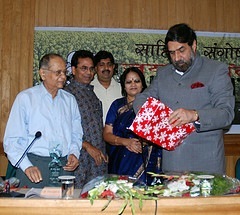
इसी कार्यक्रम में डायमण्ड पब्लिकेशंस के श्री नरेन्द्र कुमार के सौजन्य से वरिष्ठ साहित्यकार श्री अजित कुमार को हिन्दी सॉफ्टवेयर "सुविधा" से सज्जित एक लैपटॉप भेंट किया गया तथा 'जयजयवंती सम्मान' से नवाज़ा गया।
कार्यक्रम के सूत्रधार डॉ. अशोक चक्रधर पिछले चौदह महीने से 'हिन्दी का भविष्य और भविष्य की हिन्दी' शीर्षक से गोष्ठियां आयोजित करते आ रहे हैं। उनका लक्ष्य है कि हिन्दी के वरिष्ठ साहित्यकार कम्प्यूटर प्रयोग में दक्ष बन सकें ताकि नई पीढ़ी से उनका संवाद सशक्त हो तथा हिन्दी साहित्य का व्यापक स्तर पर प्रचार और प्रसार हो। इस अवसर पर मुख्य अतिथि विदेश राज्य मंत्री श्री आनंद शर्मा ने जहां एक ओर काका हाथरसी के हास्य चिंतन में गांधीवादी अवधारणाओं को रेखांकित किया वहीं दूसरी ओर जयजयवंती के प्रयासों की सराहना की। समारोह में हिन्दी के अनेक वरिष्ठ साहित्यकार तथा हास्य कवि उपस्थित थे यथा, डॉ. गंगा प्रसाद विमल, डॉ. ओम विकास, हॉलेण्ड के डॉ. मोहन कांत गौतम, हास्य कवि सुरेन्द्र शर्मा, महेन्द्र अजनबी, वेद प्रकाश, अरुण जैमिनी, डॉ. शेरजंग गर्ग, रवि-नलिनी जैन, पवन दीक्षित, उदय प्रताप सिंह, पद्माकर पांडेय आदि। हिन्दी सॉफ्टेवेयर की ओर से श्री चंचल चौहान को 'सुविधा' हिन्दी सॉफ्टवेयर पैकेज एवं शॉल से सम्मानित किया गया। डॉ. अशोक चक्रधर ने इस अवसर पर काका हाथरसी के व्यक्तित्व और कृतित्व से जुड़ी एक मल्टी-मीडिया प्रस्तुति दिखाई जिसका शीर्षक था- हास्य की हार्ड ड्राइव: काका हाथरसी। पुरस्कृत कवि श्री आशकरण अटल की कविताओं को बहुत चाव से सुना गया।
चित्र कला संगम के सचिव पद्मश्री वीरेन्द्र प्रभाकर एवं डायमण्ड पब्लिकेशंस के सौजन्य से डॉ. अशोक चक्रधर के बारे में एक पुस्तिका का लोकार्पण भी हुआ। जिसका शीर्षक था— 'ये हैं अशोक चक्रधर'।
कार्यक्रम के व्यवस्थापक प्रवासी संसार के संपादक श्री राकेश पांडेय ने बताया कि 'जयजयवंती' कार्यक्रमों की यह श्रृंखला सतत गतिमान रहेगी और हिन्दी के ग्लोबल स्वरूप को विकसित करने का अभियान जारी रहेगा।
रिपोर्ट एवं चित्र : मीनाक्षी पायल
साहित्य समाचार
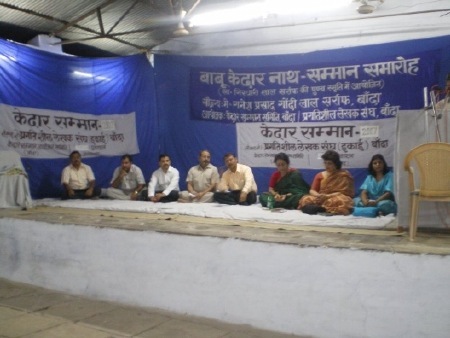
प्रगतिशील हिन्दी कविता के शीर्षस्थ कवि केदारनाथ अग्रवाल की स्मृति में दिया जानेवाला चर्चित 'केदार सम्मान- २००७' २७ सितम्बर २००८ को बान्दा नगर के आर्य कन्या इन्टर कॊलेज के हॊल में समकालीन हिन्दी कविता की चर्चित कवयित्री अनामिका को उनके कविता संकलन "खुरदुरी हथेलियाँ" के लिए, प्रख्यात आलोचक डॊ.मैनेजर पाण्डेय के हाथों प्रदान किया गया।
इस अवसर पर बोलते हुए डॊ.मैनेजर पाण्डेय ने कहा " खुरदुरी हथेलियाँ" की कविताओं में भारतीय समाज एवम् जनजीवन में जो हो रहा है और होने की प्रक्रिया में जो कुछ खो रहा है उसकी प्रभावी पहचान और अभिव्यक्ति है। अनामिका की कविता में सामान्य जन के जीवन और उनके दु:ख-सुख को दर्ज करने की भावना प्रबल है, इसलिए केदारनाथ अग्रवाल के वैचारिक मूल्यों के बहुत करीब हैं। मैनेजर पान्डेय के अतिरिक्त जितेन्द्र श्रीवास्तव व पत्रकार अंजना बख्शी ने भी अनामिका को सम्मान हेतु शुभकामनाएँ दीं।
सम्मान ग्रहण करते हुए अनामिका ने कहा कि यह क्षण मुझे अभिभूत कर रहा है। केदारनाथ अग्रवाल को याद करते हुए अनामिका ने कहा - वे सहज जीवन और सहज कविता के अद्भुत चितेरे कवि थे।
केदार सम्मान के इसी क्रम में डॊ. मैनेजर पाण्डेय द्वारा युवा आलोचक जितेन्द्र श्रीवास्तव को 'डॊ. रामविलास शर्मा आलोचना सम्मान' से सम्मानित किया। इस अवसर पर जितेन्द्र श्रीवास्तव को बधाई देते हुए डॊ. रघुवंशमणि त्रिपाठी ने कहा कि जितेन्द्र श्रीवास्तव ने स्त्री, दलित, साम्प्रदायिकता और किसान समस्या से जुड़े मुद्दों के परिप्रेक्ष्य में प्रेमचन्द के लेखन को देखने का नूतन प्रयास किया है, यह आकलन इन्होंने ऐसे समय में प्रस्तुत किया जब प्रेमचन्द को स्त्रीविरोधी बताया जा रहा है।जितेन्द श्रीवास्तव ने समकालीन हिन्दी कविता को उसकी समग्रता में विभिन्न कवियों के माध्यम से देखने का प्रयास किया है जिससे एक नई दृष्टि विकसित होती नजर आ रही है। तत्पश्चात जितेन्द्र श्रीवास्तव ने केदार शोध पीठ न्यास, 'उन्नयन' पत्रिका व मैनेजर पाण्डेय का आभार प्रदर्शित किया।
इन दोनों सम्मानों के पश्चात डॊ. मैनेजर पाण्डेय द्वारा केदारनाथ अग्रवाल की चुनी हुई कविताओं का विमोचन किया गया। इस महत्वपूर्ण चयन का सम्पादन व चयन 'केदार शोध पीठ न्यास' के सचिव एवम् समकालीन हिन्दी कविता के महत्वपूर्ण कवि नरेन्द्र पुण्डरीक ने किया है। इस चयन का प्रकाशन अनामिका प्रकाशन इलाहाबाद द्वारा किया गया है। साथ ही इस अवसर पर लक्ष्मीकान्त त्रिपाठी के गज़ल-संग्रह का विमोचन भी डॊ. पाण्डेय द्वारा किया गया। इसका प्रकाशन भी अनामिका प्रकाशन द्वारा किया गया है।
केदार सम्मान के अवसर पर हैदराबाद से पधारे डॊ. ऋषभदेव शर्मा ने अपने वक्तव्य में कहा कि मेरा आने का सबसे बड़ा उद्देश्य कवि केदार की इस पावनभूमि को प्रणाम निवेदित करना था। आगे बोलते हुए उन्होंने कहा कि केदार की कविता मानवीय संघर्षों के प्रति अखण्ड विश्वास की कविता है। केदार से हुई अपनी भेंट के संस्मरण सुनाते हुए उन्होंने बताया कि केदार बाबू आयु के जिस शिखर पर बैठे थे, उनसे चर्चा के बाद यह उभर कर आया कि उस समय वे मृत्यु के विषय में अधिक सोचते थे।जनवाद उन्हें नहीं सुहाता। डॊ. शर्मा ने बल दिया कि केदार जी की कविताओं के कुछ नए पाठ तैयार किए जाने की आवश्यकता है,जिन्हें उनके अलग अलग काल से जोड़ कर देखे जाने से कुछ नए तथ्य उद्घाटित होंगे।
केदार शोधपीठ व सम्मान समिति के निमन्त्रण पर पधारीं "विश्वम्भरा" की संस्थापक महासचिव डॊ. कविता वाचक्नवी ने केदार के व्यक्तित्व एवम् कृतित्व पर अपना मत व्यक्त किया व उन्हें जातीय परम्परा का कवि बताया और कहा कि जातीय परम्परा में देश की धरती, धरती पर रहने वाले लोग और उन लोगों की सांस्कृतिक विरासत, मूल्य व सभ्यता आदि सभी गिने जाने चाहिएँ । यह भी रेखांकित किया कि एक या दो या दस संकलन या पुरस्कार आ जाने से कोई रचनाकार बड़ा नहीं होता है अपितु अपनी जातीय परम्परा में अपने सकारात्मक अवदान से उसका मूल्यांकन किया जाना चाहिए। डॊ. वाचक्नवी ने केदार के व्यक्तित्व में निहित औदात्य की चर्चा की और उसे वह मूल तत्व बताया जिससे रचना वास्तव में कालजयी हो जाती है। केदार जी के व्यक्तित्व व कृतित्व में निहित पारदर्शिता का उन्होंने विशेष उल्लेख किया।
इस अवसर पर बोलते हुए केदार शोध पीठ के सचिव नरेन्द्र पुण्डरीक ने कहा कि केदार की कविता में चाहे केन नदी के सौन्दर्य के उद्दाम चित्र हों, वासन्ती हवा हो, गाँव का महाजन हो, बुन्देलखंड के लोग हों, पैतृक सम्पत्ति हो या मजदूर के जन्म की कविता हो , सभी कविताओं की भाव छवियाँ और सौन्दर्य बिम्ब अपनी धरती कमासिन में रहते हुए उनके मन में खचित हो चुके थे।
अध्यक्ष पद से बोलते हुए डॊ. मैनेजर पाण्डेय ने कहा कि कविता एवम् साहित्य के क्षेत्र में सावधानी बरतना बहुत आवश्यक है। उन्होंने कहा कि केदार जी साहित्य के बहुत बड़े पुरोधा हैं। केदार की कविता में विविधता एवम् व्यापकता है। कविता संस्कृति का निर्माण करती है और उसका संरक्षंण करती है। केदार जी अपने क्षेत्र की प्रकृति के कवि हैं। प्रकृति का संस्कृति से गहरा रिश्ता होता है।चूंकि केदार प्रकृति के कवि हैं अत: वे संस्कृति का निर्माण करते हैं। केदार जी की कविताएँ मनुष्य को सामाजिक बनाती हैं।
आयोजन के इस सत्र में मुख्य रूप से इनके अतिरिक्त ज्योति अग्रवाल (केदार जी की बहू), लक्ष्मीकान्त त्रिपाठी, द्वारका प्रसाद मायछ( हैदराबाद), डॊ. रामगोपाल गुप्ता, योगेश श्रीवास्तव, चन्द्रपाल कश्यप, पवन कुमार सिंह, श्री अरुण निगम (चेयरमैन के.सी.एन.आई.टी.), विजय गुप्त आदि ने सक्रिय भागीदारी निभाई। इस सत्र का संचालन 'वचन' पत्रिका के सम्पादक प्रकाश त्रिपाठी ने किया और आभार श्री प्रकाश मिश्र सम्पादक 'उन्नयन' एवम् विनोद शुक्ल 'अनामिका प्रकाशन, इलाहाबाद' ने किया।
आयोजन के सायंकालीन चरण में कविसम्मेलन सम्पन्न हुआ। जिसका संचालन डॊ. अश्विनी कुमार शुक्ल ने किया । नगर पधारे साहित्यिक आगन्तुकों को विशेष रूप से केदार जी के आवास पर भी रात्रि में ले जाया गया। जीर्ण शीर्ण दशा में पड़े उस आवास व केदार जी की सामग्री आदि को देख कर सभी ने अत्यन्त चिन्ता प्रकट की व स्थानीय प्रशासन द्वारा सरकार की सहायता से इस स्थल को केदार स्मारक के रूप में विकसित करने की माँग करते हुए कहा कि शीघ्रातिशीघ्र ऐसा किया जाना अपेक्षित है।
योगेश श्रीवास्तव
बाँदा
*****
In the end something to be proud of ;
October 10, 2008, 9:34 am
Neel Kashkari: A Portrait of the $700 Billion Man as a Young Banker Posted by Heidi N. Moore
Who is Neel Kashkari?
We’ll get to that in a second. Here is who he is not: Neel Kashkari is not a wunderkind. He’s not an evil genius. He’s not a mastermind.
Kashkari, the 35-year-old interim head of the Office of Financial Stability, has been the source of great worry. Many fear he’s too young and too inexperienced to handle the task of rebuilding the nation’s financial system.
(Getty Images)
Of course, Kashkari may just have the job for a few months. Paulson made clear he will appoint somebody and try to get the new person confirmed in November, and that person would transition into the next administration.
Forty-five days isn’t a long period in normal times, but in this crisis it’s an age. To get a better understanding of him, Deal Journal spoke to people who knew Kashkari well in his childhood and during his time at Goldman Sachs to find out the character and working style of the man who is managing the nation’s bailout.
Here’s the portrait that emerged: Kashkari is smart, dutiful, detail-oriented, and takes orders well. In the parlance of investment banking, he is a good “execution guy”: He leaves strategy to the bigwigs. But if you give him a project, he will prioritize, delegate and finish it.
These people report he has an amiable manner and is a good, intent listener. He doesn’t make waves and never dominates a discussion; he thinks before he speaks and he lets people express themselves. He is particularly good at presenting complicated ideas and leading team projects that depend on gaining cooperation from others. Those include the Sunrayce project to build a solar car as well as his work on the space telescope. “Neel is just plain good, with a high standard of ethics,” said Dr. Surinder Bhardwaj, a Hindu community priest who is a close family friend to the Kashkaris in Ohio. “This is a responsibility that requires the interest of the nation as a whole, and requires a very strong base of morality, which he has.”
Kashkari comes from a small, tight-knit community of Indian Hindus in Ohio, where his parents had a high profile in the local community. His mother, a pathologist, was known as a community resource. “She’s a good listener and helps guide people out of stressful situations,” said Dr. Bhardwaj. “They are very compassionate people, his parents, and maybe that’s where he’s getting his value system from.” Kashkari’s father is a retired engineer with a bent to public service, particularly in West Africa, where he spearheaded efforts to bring electricity and clean water to poor villages. Kashkari met his wife, Minal, in college at the University of Illinois Urbana-Champaign. They were married in a traditional Indian ceremony in Chicago where participants remember the bride being carried in on a festive palanquin and Kashkari, busy even then, taking the time to put each guest at ease.
Kashkari first worked at Goldman Sachs during the summer between his two years at Wharton, and impressed well enough to get a full time job after graduation. Academically, Kashkari was not outstanding, said a person familiar with the matter, but he appealed to Goldman’s recruiters because, as a former engineer, he was different than the usual aspiring investment banker. Kashkari’s head – shaved bald even then – also differentiated him from the reigning Goldman aesthetic, sometimes mockingly referred to as “The Borg” by rivals. “Everyone at Goldman has a full head of hair and went to prep school and Dartmouth and played lacrosse. That’s not Neel,” said an investment banker who knew him.
Goldman’s investment bankers were most impressed by Kashkari’s science background. His experience working on the James Webb Space Telescope for NASA contractor TRW gave him a comfort with technological jargon that would help Kashkari communicate with technology-company executives. Kashkari also spoke passionately of his entry in a car competition, the 1997 Sunrayce event in which Kashkari’s team built and raced a solar-powered car. His team didn’t win, but it did earn kudos. While other bankers at Goldman would often discuss their project du jour or details of a presentation even in their off-time, Kashkari often discussed cars and the Sunrayce experience.
When Kashkari returned to Goldman Sachs after business school, he worked with senior bankers advising companies in the software sector. As a junior banker, he did not have many responsibilities of his own; it was his job to prioritize and execute on the tasks given to him by others. (In many ways, that has also been Kashkari’s job at Treasury, where the strategy has been set by Hank Paulson.)
Kashkari did well enough that his bosses gave him an obscure sector to research and cover : information technology software, which included antivirus-program makers. The sector included many tiny companies that rarely hired or needed investment bankers, and Goldman Sachs did not have meaningful relationships with the leading companies. Kashkari impressed colleagues with his technical skill. Much of his job, however, was building relationships, a task that, in the world of investment banking, takes years. Although a few mergers and financings emerged from his work, many were not publicly disclosed because of their small size.
After Kashkari had spent only a couple of years covering IT software, the head of Goldman Sachs’s technology group, George Lee, recommended him to Paulson, who had then moved to Treasury.
“I never thought I’d see him in government,” said one banker who knew him. “He enjoyed being a banker and the respect that was conferred on him as being a Goldman banker.” The rest, as they say, is history.


 Listen ...
 Said a blade of grass to an autumn leaf, "You make such a noise falling! You scatter all my winter dreams."


 The room was warm and clean, the curtains drawn, the two table lamps alight-hers and the one by the empty chair opposite. On the sideboard behind her, two tall glasses, soda water, whiskey. Fresh ice cubes in the Thermos bucket.
 And in the other room, Mary Maloney began to giggle.
 One of my most enduring memories of early childhood was my friendship with Joss Spivvis. It all started in the early 1920s, not long after my father and my eldest sister had both died within a few weeks of one another. The remainder of our large family, consisting of my mother and six children, had moved to a house in Llandaff, near Cardiff, which was called Cumberland Lodge.
  Charlie and the Chocolate Factory took me a terrible long time to write. The first time I did it, I got everything wrong. I wrote a story about a little boy who was going round a chocolate factory and he accidentally fell into a big tub of melted chocolate and got sucked into the machine that made chocolate figures and he couldn't get out. It was a splendid big chocolate figure, a chocolate boy the same size as him. And it was Easter time, and the figure was put in a shop window, and in the end a lady came in and bought it as an Easter present for her little girl, and carried it home.
 Once upon a time there was a town called Hamelin. It was a small but very rich town. It stood on the beautiful banks of the river Wiser. People of this town, were wealthy, but very greedy and stingy.
  A birdie with a yellow bill
 "Come said the wind to
  For summer is gone
 SRIHARIKOTA: India on Wednesday rocketed into the big league of exclusive lunar club with a precision launch of its moon mission, Chandrayaan-1, at
  इंडिया हैबिटेट सैंटर में विगत आठ अक्तूबर को जयजयवंती सहित्य संगोष्ठी के संयुक्त तत्वाधान में 34वां काका हाथरसी पुरस्कार मुम्बई के हास्य कवि श्री आशकरण अटल को प्रदान किया गया। पुरस्कार के रूप में उन्हें एक लाख रुपए का चैक, मानपत्र, श्रीफल और शॉल प्रदान किए गए। काका हाथरसी पुरस्कार ट्रस्ट के सचिव श्री अशोक गर्ग ने मानपत्र का वाचन करते हुए बताया कि श्री आशकरण अटल को हास्य रत्न की उपाधि से नवाज़ा जा रहा है।
  चित्र कला संगम के सचिव पद्मश्री वीरेन्द्र प्रभाकर एवं डायमण्ड पब्लिकेशंस के सौजन्य से डॉ. अशोक चक्रधर के बारे में एक पुस्तिका का लोकार्पण भी हुआ। जिसका शीर्षक था— 'ये हैं अशोक चक्रधर'।
 कार्यक्रम के व्यवस्थापक प्रवासी संसार के संपादक श्री राकेश पांडेय ने बताया कि 'जयजयवंती' कार्यक्रमों की यह श्रृंखला सतत गतिमान रहेगी और हिन्दी के ग्लोबल स्वरूप को विकसित करने का अभियान जारी रहेगा।
  प्रगतिशील हिन्दी कविता के शीर्षस्थ कवि केदारनाथ अग्रवाल की स्मृति में दिया जानेवाला चर्चित 'केदार सम्मान- २००७' २७ सितम्बर २००८ को बान्दा नगर के आर्य कन्या इन्टर कॊलेज के हॊल में समकालीन हिन्दी कविता की चर्चित कवयित्री अनामिका को उनके कविता संकलन "खुरदुरी हथेलियाँ" के लिए, प्रख्यात आलोचक डॊ.मैनेजर पाण्डेय के हाथों प्रदान किया गया।
 इन दोनों सम्मानों के पश्चात डॊ. मैनेजर पाण्डेय द्वारा केदारनाथ अग्रवाल की चुनी हुई कविताओं का विमोचन किया गया। इस महत्वपूर्ण चयन का सम्पादन व चयन 'केदार शोध पीठ न्यास' के सचिव एवम् समकालीन हिन्दी कविता के महत्वपूर्ण कवि नरेन्द्र पुण्डरीक ने किया है। इस चयन का प्रकाशन अनामिका प्रकाशन इलाहाबाद द्वारा किया गया है। साथ ही इस अवसर पर लक्ष्मीकान्त त्रिपाठी के गज़ल-संग्रह का विमोचन भी डॊ. पाण्डेय द्वारा किया गया। इसका प्रकाशन भी अनामिका प्रकाशन द्वारा किया गया है।
 आयोजन के सायंकालीन चरण में कविसम्मेलन सम्पन्न हुआ। जिसका संचालन डॊ. अश्विनी कुमार शुक्ल ने किया । नगर पधारे साहित्यिक आगन्तुकों को विशेष रूप से केदार जी के आवास पर भी रात्रि में ले जाया गया। जीर्ण शीर्ण दशा में पड़े उस आवास व केदार जी की सामग्री आदि को देख कर सभी ने अत्यन्त चिन्ता प्रकट की व स्थानीय प्रशासन द्वारा सरकार की सहायता से इस स्थल को केदार स्मारक के रूप में विकसित करने की माँग करते हुए कहा कि शीघ्रातिशीघ्र ऐसा किया जाना अपेक्षित है।
 Who is Neel Kashkari?
  “I never thought I’d see him in government,” said one banker who knew him. “He enjoyed being a banker and the respect that was conferred on him as being a Goldman banker.”
